

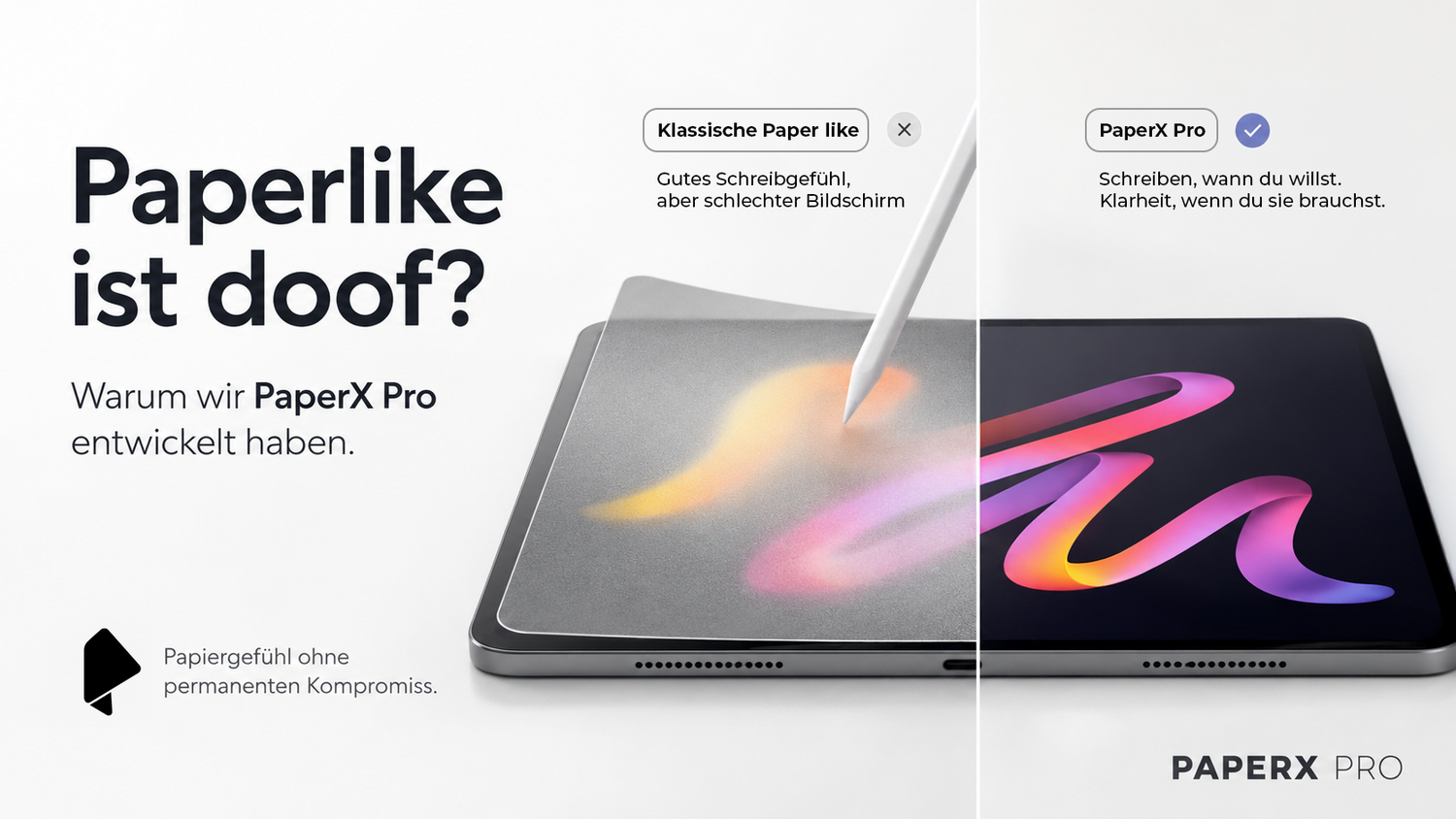
Okay, maybe "dumb" is a little harsh.
But only a little.
Of course we get why Paperlike screen protectors exist. Writing on glass feels about as natural as signing your name on a mirror with a ballpoint pen. The Apple Pencil slips, you lack control, and somehow everything feels a bit too digital.
And the fact that this problem got solved in the first place is thanks to Jan (the founder of Paperlike) <3
But: unfortunately, that solution isn't really perfect either.
You stick a matte, textured film onto your iPad. And suddenly writing feels better, but the screen looks like someone laid a light gray haze over it.
Great for writing.
Not so great for what you actually have an iPad for. Whether that's watching movies, looking at drawings or editing photos.
And that's exactly where our story began.
We were students. And we had an iPad problem.
As students, we used our iPads every day. Notes, homework, sketches, PDFs, presentations. Everything ran through that one device.
And the more we wrote with the Apple Pencil, the clearer it became: writing on glass just isn't it.
So we tried whatever was out there at the time.
Classic Paperlike screen protectors.
Matte screen protectors.
Cheap screen protectors.
Expensive screen protectors.
Screen protectors that were supposed to feel like paper but felt more like "well, at least it's not glass".
The result was usually the same: either the writing feel was okay, but the screen looked worse. Or the screen stayed reasonably clear, but there was barely any paper feel.
Somehow you always had to choose:
Writing feel or screen quality.
And honestly: we thought that was pretty dumb.
So we founded Paperize
At some point, we'd had enough of always choosing between two bad compromises.
Together with a few friends, we founded Paperize. Not because we thought: "Wow, the world desperately needs another iPad screen protector."
But because we wanted a solution for ourselves that simply didn't exist.
We wanted a writing feel that comes closer to paper. But without making the screen permanently matte.
Because why buy an iPad with a high-quality display, only to stick a rough, matte layer over it 24/7?
When writing: yes, more resistance, please.
When watching movies: screen back, please.
When drawing: clear colors, please.
When reading: no permanent gray haze, please.
That doesn't actually sound that crazy. It's just that, back then, this solution didn't really exist for us.
So we started developing it ourselves.
The idea became PaperX
Our first cool product was PaperX. (Yes, there were a few other "experiments" before that)
The idea behind it was simple: a screen protector you can use when you want to write, and take off again when you want to use your iPad normally.
No permanent compromise.
No permanently matte surface.
No "well, your display is just a bit worse forever now".
For us, PaperX was the first real step in the direction we'd been wishing for ourselves.
But as is always the case with real products: the first version is rarely the last.
We tested. Collected customer feedback. Tested again. Compared materials. Removed magnets. Improved adhesion. Tweaked the writing feel. Optimized transparency. Made mistakes. Scrapped things. Started over.
In short: it was less "we had an idea and it was instantly perfect" and more "we tinkered with very small details for a very long time until it finally got really good".
Then came PaperX Pro
After many iterations, PaperX finally became PaperX Pro.
And the leap was huge.
PaperX Pro feels much more natural, gives you more control when writing and comes a lot closer to what we would have wished for back when we were students.
Still not 100% paper. Sadly, your iPad doesn't magically turn into a notebook fresh from the tree.
But very, very close.
Many of you describe the writing feel as much better than on glass and about 90% like paper. That was exactly our goal: that natural, controlled writing feel without permanently sacrificing your screen.
Why we're still critical of classic Paperlike screen protectors
Our take is pretty simple:
Classic Paperlike screen protectors solve a real problem, but they often create the next one right away.
Yes, they improve the writing feel.
But they make your screen permanently more matte.
And the stronger the paper feel, the rougher the surface usually is. The rougher the surface, the more the display's clarity tends to suffer.
When manufacturers try to make the screen protector more transparent, some of the paper feel often gets lost again.
So it's always a compromise.
And that's exactly the compromise we didn't want to accept anymore.
PaperX Pro isn't for everyone. But it's just right for a lot of people.
If a matte screen surface doesn't bother you, you can apply adhesive screen protectors perfectly without air bubbles, and you mainly use your iPad for writing: then a classic Paperlike screen protector can be absolutely perfect for you.
But if you use your iPad for more: writing, drawing, shows, YouTube, photos, presentations, university, school, work... then you might not want to look through a matte layer all the time.
PaperX Pro is for anyone who wants a paper feel when writing, but wants to use their iPad like an iPad again afterwards.
Write when you want to write.
A clear display when you need it.
Pretty logical, really.
And that's exactly why we founded Paperize.

Leave a comment
This site is protected by hCaptcha and the hCaptcha Privacy Policy and Terms of Service apply.